
Thursday 21 July 2016
Swengmania! – The Swenglish film goes truly international
The Swenglish documentary by Adriana Sabau, based on my Swenglish project (and book) has gone truly international!
At the end of August there will be a somewhat belated launch party for the film in Romania.
The film has also been accepted and will be shown at two international film festivals:
TrueDoc Documentary Festival in the Ukraine in September
and Barcelona Planet Film Festival in Spain
Follow Swenglish on Facebook for more information
Buy the book
PÅ SVENSKA

Thursday 17 December 2015
Swenglish/Svenglish is now complete!

For more info about the English book please click here.
För mer info om den svenska boken, klicka här.
The Swenglish/Svenglish project on Facebook
Monday 19 October 2015
Swenglish has a big sister!

Jakten på den perfekta puben ("The Hunt for the Perfect Pub") is the name of Kristina Svensson's masterpiece. It's set in Wales and describes her experience of living and working there. She also visits quite a few pubs. Obviously.
The book is a masterpiece in my point of my view because I recognise so many British quirks.
Messy backyards, page 36:
Kristina writes about the backyards of houses that you see from train windows. She wonders why nobody has ever thought of having two "fronts" of the house. As if they were oblivious to people on trains who can look straight at their backyard mess.
Unreasonable showers, page 64:
The author feels cheated by the expression "power shower". Your only choice is a "forceful cold shower" or a "hot trickling shower".
Lack of signposts, page 211:
If you go hiking in Britain it's easy to get lost as the signposts are usually well hidden. Something Kristina experiences in Usk valley. (This makes me think of when I was going to take my mum for a walk to Beachy Head and we had to call a taxi to even find the starting point from the bus stop.)
Queuing without clothes, page 255:
The author and I agree that people in Britain seem to lack outer garments like jackets. Especially when they queue outside night clubs.
Thank you, Kristina for an entertaining read!
And please don't be offended, we do love you, Britain!
The Swedish version of my book Svenglish which contains similar anecdotes will be out in November. Click here to see the invitation to my launch party.
Thursday 20 August 2015
The Best and the Worst becomes an App

Every night before bedtime, as a part of the Swenglish project, I asked the participants about their worst and best moment of the day.
The idea comes from my own family who used to do this routine when we were on holiday. A chance to reflect and get to know each other better. Sometimes the best moment could be something small. Like the melon for breakfast tasting good. Sometimes it could be a bigger thing. Like a phone call from a long lost friend. The worst moment can also be small or big. Like rain when you were about to swim. Or a colleague being rude at work.
The world is not black and white. It's not always easy to pick one single moment. But it's interesting to see what pops up in your head. And if you do it regularly you will be able to notice what makes you happy and what annoys you.
One of the Swenglish participants liked "the best and the worst" so much that he made a mobile app to track your best and worst, and it can even remind you to enter them daily. You can download Duality for iPhone from the App Store. Full details at the Duality website.
PÅ SVENSKA
PÅ SVENSKA
Thursday 30 July 2015
Bless you!

Scenario:
I walk down
a busy street in London and I happen to sneeze. An older lady in the crowd
smiles at me and says bless you. I
immediately think ”this would never happen in Sweden”.
A month
later I walk down a not-so-busy street in Gothenburg. A man happens to sneeze.
Another man says prosit (the Swedish
equivalent to bless you). I
immediately think ”this could happen in Sweden after all”. But when the man
walks past me, I get a whiff of alcohol in my face. I change my mind to ”this
only happens in Sweden if you’re drunk”.
Wednesday 22 July 2015
A Hot Water Bottle

Time to start working again after lazing about in the forest and swimming in lakes. The Swedish version of Swenglish just arrived in the post from the proofreader.
One thing I have to consider is the translation of "hot water bottle" as hot water bottles aren't that common in Sweden and people call it different things.
Tuesday 14 July 2015
Reader Reactions to Swenglish

"I have almost finished reading it and wish it was longer - I don't want it to end!"
"I’ve now read Swenglish and was really impressed. Two sentences I loved: ‘The fans seemed quite bored; to win so easily has no meaning. ‘A woman who keeps interior design magazines under her mattress as if they were porno mags.’ I liked the section up near Umeå a lot. You’re less of a naïve writer now, I think, but still an unsentimental one."
"Our mate X stayed over last night, this morning he's flicking through Swenglish and chuckling away! He's thinking of going online and getting his own copy."
Above are some quotes from friends and acquaintances who have read Swenglish - a journey through everyday life.Some writers say they only write for themselves. I don't believe them. If you're the kind of writer who keeps everything in a drawer fair enough, but if you go ahead and publish something, I think you secretly want reactions.
I'm very happy that someone has bothered to write an Amazon review and there's also a short review at Good Reads!
Thanks everyone for spreading the word so far!
You can read the prologue here. (By clicking on "Look inside")
You can read the prologue here. (By clicking on "Look inside")
Thursday 18 June 2015
Swenglish in English media!
Interview with The Latest TV, please click on the film clip above
Interview in the Argus
Swenglish in The Brighton Source
Interview on CATV On The Radio show
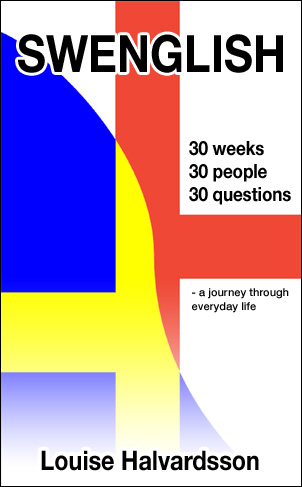
Swenglish - a journey through everyday life
is now available from Amazon
both in paperback and Kindle edition.
If you are in the Brighton area you can also find a copy at City Books.
Follow The Swenglish project on Facebook
Thursday 4 June 2015
Welcome to the Swenglish Launch Party!

When? Saturday 13 June, 3 pm
Where? Northern Lights, 6 Little East Street, Brighton
What? A party to celebrate the launch of
Swenglish - the book by Louise Halvardsson
& Swenglish- the film by Adriana Sabau
How? Free entry, free Swedish sweets,
the book will be available for sale
Why? Because it's fun
Click here for more info:
THE SWENGLISH LAUNCH PARTY EVENT
PÅ SVENSKA
Monday 1 June 2015
Question 30b: What's your Biggest Dream?
- "When you stop dreamin' it's time to die" - Blind Melon
 |
| Time for dreams. Walk from Brighton to Rottingdean during project week 7. |
One reason why I embarked on the Swenglish journey was that I had stopped dreaming. I thought that I'd experienced everything that was worth experiencing in life.
I longed for nothing. That's why I asked the 30 Swenglish participants about their dreams. In hope of new inspiration, visions and life joy.
What people in England dreamed about
“To find love again, to be capable of loving”
“More
recognition of my work as a poet”
“Getting
my books published. Having my own security, my own property”
“Living in a complete freedom. Not being dependent on the monetary system, being completely off the grid, having my own family that feel very supportive of each other”
“To
always be really good at what I’m doing at the moment”
“To
win an Oscar for a highly acclaimed film performance”
“To have money and be able to do creative things full time”
“To have a healthy family”
“To feel like I've done something worthwhile while I was on earth, to feel that wehn I do die I've done something that I'm really proud of”
“To
win the Pulitzer Prize and go round the world on book tours”
“I
just want to be happy, enjoying my work, my environment and my friends”
“Being well in my head”
“To
have enough of a career to keep me safe. Carry on doing what I’m doing”
“To
be in the body I want to be in, to be a really beautiful woman”
“To come to some kind of global situation where the whole human population realises that we're all interconnected and somehow get global politics to reflect that”
What people in Sweden dreamed about
“To create something that can affect another person, no matter if it's a record or a book”
“That my child will lead a happy life”
“Simply to feel happy, to somehow become a whole person”
“To live in a Västerbotten cottage, work as an archaeologist and for everything ot be hunky-dory”
“Being
healthy and be able to travel a lot”
“That it will be peace and everyone's essential needs will be met ”
“To make music and put out records that people will love and be touched by for decades to come"
“That my children will have whole and healthy families"
“Writing a bestselling novell"
“To become a designer and work with what I want to do. And have a family"
“To move on within the union and that it goes well. Start writing again"
“To get rid of my back ache and that my mum gets rid of her back ache"
“That all violent conflicts would end"
“A holiday home abroad where you can live in winter"
“To be happily in love and that it's mutual"
Health, love and creative success
People are quite similar really. Many mostly wish for good health. Because if you don't feel well everything feels hard. A trivial conclusion that anyone could have come up with. But sometimes you (read I) need to be reminded.
And love is very important. But a traditional relationship with only one partner isn't the only love there is. During the project I realised how important friends are. Different friends. Many friends.
And then we have the creative success ... Of course it would be fantastic to write a bestseller. But that's no guarantee for happiness. Now, 2,5 years after I finished the Swenglish project, I still don't have any grand dreams. But I dream a bit everyday. About writing a really good poem. About being able to make my whole living from different writing jobs. About ... yes, to feel okay with just being me and not care about what other people think. Then it would be nice with peace on earth of course. I admire those Swenglish participants who looked outside themselves and dreamed about a better world for all people.
This study is by no means scientific, the answers are based on interviewing 15 people in England and 15 people in Sweden, aged 22-59. This was the last questions, but I will still share my Swenglish thoughts on this blog now and again, so please come back!
Tuesday 26 May 2015
Question 30a: What's Your Biggest Fear?

Biggest fears of people in England:
“Losing my mind and knowing I’ve lost it.”
“Centipedes that are bigger than me.”
“Never finding love again.”
“I fear illness quite a lot. Cancer and that.”
“Losing the ones I love.”
“Being alone.”
"Being a mad old man who’s just totally mad, unable to look after myself with no-one in the world."
"Being homeless."
"Having another breakdown."
"Something happening to the kids, them going missing, or anything like that or them being really ill."
"Getting to 80 years old and be on my own never having children or a husband."
"Being in some kind of global apocalypse, nuclear war."
"Pain, I’m really scared of pain, physical pain, not mental pain, I can handle that."
"Losing people that I love."
"Have some accident that make you paralysed in a way that you could only move your eyes."

Biggest fears of people in Sweden:
"I mostly fear death actually, but it's not really logic, I can't quite explain. I think it feels quite unpleasant to die, once I dreamed that I died."
"To be and to feel lonely I think."
"Loneliness perhaps."
"That something would happen to my child."
"Sick people that would hurt me or people I love."
"I'm a bit scared of heights."
"That something terrible would happen to my family and friends, that they would feel unwell."
"Apart from something happening to my kids, it's probably not to leave something behind, to not leave something of me in the world."
"That something would happen to my dear and near ones, then I think of family and friends like."
"That something would happen to someone in the family, especially to the kids, them getting hit by a deadly disease. Sometimes you take everything for granted."
"That someone in the family would die, but I'm not thinking of that every day ... I don't really know ... that I wouldn't be able to handle it."
"That's tough. A sign that I'm not scared of that much. But sometimes I make decisions against people's will at work and I'm afraid that they'll think I've got something against them personally and that they will hunt me down, wanting to hurt me."
"That something would happen to my child. To fall ill."
"To be let down and fooled and abused and hit by a car."
"That something would happen to my family, that they wouldn't have a good life."
This study is by no means scientific, the answers are based on interviewing 15 people in England and 15 people in Sweden, aged 22-59. Look out for the next question: What's your biggest dream?
Monday 11 May 2015
Question 29: Do you Believe in God?
The English are more open for spirituality than the Swedes

Only one of the Swenglish project participants in Sweden and only one of the participants in England answered a straight "yes" when asked "Do you believe in God?"
Most Swedes answered with a clear no, only a couple of people started talking about some kind of spiritual energy. And one person said:
"Only when I'm in a situation where everything is going tits up... Then I go a bit religious and start praying, as and when it suits."
"Only when I'm in a situation where everything is going tits up... Then I go a bit religious and start praying, as and when it suits."
The people I stayed with in England were more open for spiritual stuff. A majority believed there was "something more to it" even if they couldn't explain what it was. One person called herself a pagan and a couple of people were involved in meditation or yoga movements. A typical answer was:
”I believe there’s some kind of unifying being that connects all things, a sort of unity, nor good or bad. Like nature it can be cruel or dispassionate.”
This study is by no means scientific, the answers are based on interviewing 15 people in England and 15 people in Sweden, aged 22-59. Look out for the next question: What's your biggest fear?
Tuesday 21 April 2015
Swenglish Documentary Trailer
Film maker Adriana Sabau followed me with her camera when I did my Swenglish project. Staying with 30 people for 30 weeks to celebrate my 30th. An odd celebration, I know. It was more of an escape...
PÅ SVENSKA
Monday 13 April 2015
Question 28: What's Your Political Views?

Unhappy but passive
During the Swenglish-project, the conservatives were in power in both England and Sweden. Just about everyone I stayed with were unhappy with the political situation. Had opinions about what was wrong and how unfair everything was. The rich getting richer and the poorer getting poorer. But very few tried to do something about it.
"I have strong social values but don’t see them reflected in what most political parties represent./.../The current situation? I probably don’t know enough of what’s going on to make an intelligent response."
- young English woman
Green Values to the Left of the Middle
At least all participants voted. Apart from one person in England who thought that the system was corrupt. Only two of the participants in England were politically active, not in a party, but they regularly took part in marches and expressed their opinions through their art. There were also a few that had actively chosen an alternative green life style and only bought organic and local products. Something that can be seen as a political choice. A majority of the people I stayed with in England voted for the The Green Party in the latest election.
In Sweden two people were into party politics or were active members of the union. And a couple of people were active through grassroot movements. The people I stayed with in Sweden had generally opinions to the left of the middle, but some voted randomly and weren't that interested in politics at all.
Bubble
I learnt that politics is more grey than black and white. Or more rainbow coloured if you're trying to be positive. During my years in England I lived in a bubble and didn't follow the news at all. A liberating feeling on one hand, but on the other hand I've got a big knowledge gap to fill. To be able to change something or at least discuss something you need to know what's going on.
People More Fed Up in England
If I'm going to generalise, people in England were more fed up and unhappy with the political situation while people in Sweden were unhappy but not as fed up.
This study is by no means scientific, the answers are based on interviewing 15 people in England and 15 people in Sweden, aged 22-59. Look out for the next question: What's your attitude towards politics?
Thursday 19 March 2015
Question 27: What do you Waste Money on?

The English waste money on beer,
the Swedes waste money on food
"Rounds"
More than half ot the Swenglish participants in England said they wasted money on beer. "Rounds" aren't very common in Sweden, mostly people pay for their own drinks. This is what a person in England said:
"...buying rounds in pubs, I more often get them in than not. When you go out you can’t measure how much you want to spend, because you drink in rounds. To have a £20 round on my hands makes me a bit anxious. No bloke wants to look like he’s not got enough money."
Healthy Food
More than half ot the participants in Sweden said they wasted money on food. Some referred to eating out or not looking at the price when they went shopping. They were keen on buying food with good quality. Only one person in Sweden said he wasted money on beer, but a couple of people mentioned "going out". In England a couple of people mentioned that they wasted money on chocolate. This is what a person in Sweden said:
"Food, but eating out everyday is not a good idea. To eat good and healthily, to eat food that doesn't contain poison. I buy locally produced food, it's worth it."
Many people answered the same thing when asked what they wasted money on and what they didn't mind spending money on. Apart from alcohol and food some mentioned clothes and beauty products. The ones who were into the arts or had another passion, didn't mind spending money in that field.
PÅ SVENSKA
PÅ SVENSKA
This study is by no means scientific, the answers are based on interviewing 15 people in England and 15 people in Sweden, aged 22-59. Look out for the next question: What's your attitude towards politics?
Wednesday 11 February 2015
Question 26b: What's your Relationship to Nature?
 |
| Project week 18: I'm picking lingonberries in a forest in Småland |
A second home. Euphoric feelings. A living piece of art. Nature meant a lot to most Swenglish participants. But quite a few people mentioned that they didn't spend enough time in nature. Especially people in England.
A playground
Several people said they felt unwell if they didn't go out in nature once a week. People who lived in the countryside or the outskirts of a town had in many cases chosen to do so because of nature. Peace and quiet were important to them. Something that's harder to achieve in a big city. A person in Stockholm said:
"When I was younger nature was just there, I climbed trees... Once I asked my mum what made her happy and she said: 'When I hear a bird sing or see a beautiful flower'. I didn't get it then. Now I can appreciate nature in a different way, at the time it was just some kind of playground. But I've never been the type who brings my basket for picking mushrooms, wearing good clothes and stuff, that's not really me."
Post nature
Some people who lived in Brighton counted the sea as their nature. There were also the ones who had a different view of nature. This is the voice of a Brightonian:
"I'm post nature. I'm not especially a fan of nature documentaries, I can take it or leave it. I quite like cats and dogs, but who doesn't? I go to cities rather than the countryside."
That people in England spent less time in nature didn't come as a surprise. Even when I lived in Stockholm I was never far from a forest. No one in England mentioned activities like picking berries and mushrooms.
This study is by no means scientific, the answers are based on interviewing 15 people in England and 15 people in Sweden, aged 22-59. Look out for the next question: What do you waste money on?
Thursday 8 January 2015
Question 26a: What Do You Do in Your Spare Time?
 During the Swenglish project I tried many new leisure activities or hobbies. Going to the gym was one of them. Not something I've carried on doing though ...
I Don't Do Leisure or Hobbies
I experience the word leisure as problematic. When I went to school I always studied as much as I could. Now I write and perform as much as I can or am involved with culture in different forms. At the same time as I'm studying a bit. Sometimes I get paid for what I do, sometimes I don't.
I also find the word hobby difficult. I write and that's my life. I'm not doing gardering, cooking, knitting, TV-watching. Everything I do is connected to my writing. Okay, I go jogging. But then I usually rehearse poems in my head. Okay, I read books, but often with the ambition to learn something or get inspired by something.
I don't do leisure or hobbies. Apart from when I see other people. Then I can watch films. Have tea. Go to the pub. Talk bullshit. Hang out and just be. But many of my relationships with friends or partners have been focused on/are focused on being creative together and working with different projects.
Blurry Boundaries
Several of the project participants pointed out that if you write, play in a band, paint or do something artistic in general the boundaries between work and spare time can be blurry. For some it might be a hobby to play the guitar or perform, for others it's so much more. Even if there are few who can make a living out of their art there are many who regard their creative work as more than a hobby. It's the same for people who do sports at a higher level. It's a passion. A lifestyle.
What Do You Do To Relax?
I need to learn to relax more even when I'm on my own. When I asked the Swenglish people what they did to relax, several answered that they watched TV or films, read books, went out in nature, went for walks, sat down with a cup of tea (only the English!), drank alcohol, smoked, had a shower, had a bath (only the English!) or listened to music.
Others folded washing, looked at maps, played the guitar, played computer games, surfed the net, did crosswords, played scrabble with herself, slept, hung out with her dogs, snogged someone, did yoga, exercised, spoke to friends and made plans. Only a few listened to relaxation tapes or did meditation. And some mentioned that they never relaxed or found it hard to do so.
Others folded washing, looked at maps, played the guitar, played computer games, surfed the net, did crosswords, played scrabble with herself, slept, hung out with her dogs, snogged someone, did yoga, exercised, spoke to friends and made plans. Only a few listened to relaxation tapes or did meditation. And some mentioned that they never relaxed or found it hard to do so.
Playing Peeping Tom
Extract from Swenglish:
"I’ve always wondered what people do
with their time and their lives. When I was little, a friend and I peeped
through our classmates’ windows just to see what they were up to after school.
Somehow we weren’t quite sure about how to occupy ourselves … My friend also
found it very hard “doing nothing”. Even when she reached her 20s she used to
call me to ask how I spent my days, but now she’s got children and doesn’t have
time thinking about what she’s doing with her time."
This study is by no means scientific, the answers are based on interviewing 15 people in England and 15 people in Sweden, aged 22-59. Look out for the next question: What's your relationship to nature?
Friday 2 January 2015
Swenglish will be out in 2015!

My only resolution for 2015 is to publish the Swenglish book in English in England and have a launch party in Brighton.
It will happen. The cover is already on its way. Design: Sky Apperley.
"As a portrait of two countries the book is interesting enough. The Swedish find the English habit of carpeting toilets to be disgusting. And, despite Sweden having colder temperatures, Sweden is warmer than England, since our houses tend to be draughty and badly insulated. However, the thing I like most was the way the book sketched its characters." - James Burt has written a personal review. Click here to read it.
"As a portrait of two countries the book is interesting enough. The Swedish find the English habit of carpeting toilets to be disgusting. And, despite Sweden having colder temperatures, Sweden is warmer than England, since our houses tend to be draughty and badly insulated. However, the thing I like most was the way the book sketched its characters." - James Burt has written a personal review. Click here to read it.
Tuesday 23 December 2014
Question 25: How happy do you feel on a scale between 1 and 10?
 Before I came up with the idea for the Swenglish-project I was down at 3,5 on the happiness scale. I felt confused and didn't know what to do with my life. I still don't know really and I'm still a bit confused, but I've accepted my situation. Nowadays I'm an 8 most of the time. I needed a big change in life, so I changed country, city, social circles, occupation... A bit drastic perhaps, but it was necessary.
How happy do you feel on a scale between 1 and 10? What a stupid question. Only one out of the 30 Swenglish participants answered "I hate that kind of questions" and refused to answer. That person, who lived in England, was very wise, I think. Of course you can't measure happiness or wellness. But I asked anyway.
This how the remaning people in England answered:
5 6 6 7,5 8 8 8 8 8 8 8 8 8,5 and "8 or 9 at happy times, other times 5 or 6"
The people in Sweden answered:
6 6 6 7 7 7 7 7,5 8 8 8 8 9 10 10
The participants were asked to consider both mental and physical health, but often it goes together. More people than I'd thought had at some point seen a counsellor/therapist/psychologist and/or been on anti-depressants. According to the stats, 1 out of 4 people in both England and Sweden suffer from some kind of anxiety or depression. Even among the people who answered 8 there were people who had been diagnosed with depression. I also asked people what it would take to reach a 10. Some missed being in a relationship, others were unhappy with their career, others felt generally stressed or were anxious about the future.
PÅ SVENSKA
PÅ SVENSKA
Sources:
This study is by no means scientific, the answers are based on interviewing 15 people in England and 15 people in Sweden, aged 22-59. Look out for the next question: What do you do in your spare time?
Thursday 4 December 2014
Question 24: What's your attitude towards drugs?
I've got no photos of drugs. I'll keep this short as it could be a sensitive subject matter for the people I interviewed.
Almost all the people I stayed with in England had tried drugs. Some took drugs now and again, mostly at parties or smoking a spliff at home. Among the people in Sweden there were many who had never tried drugs and no one used drugs at the moment.
I was very naive when I moved to Brighton as a 19-year old. I thought that people just smoked long roll-ups when they really smoked a joint. Through my own observations it's clear that there are more drugs around in England than in Sweden. But now I'm talking about what it was like ten years ago and I'm aware that not all Swedes are as naive as I was.
Several of the people in the Swenglish project pointed out that alcohol was the worst drug as it's so sociably accepted.
This study is by no means scientific, the answers are based on interviewing 15 people in England and 15 people in Sweden, aged 22-59. Look out for the next question: How happy are you on a scale between 1 and 10?
Wednesday 29 October 2014
Question 23: What's your Atittude towards Alcohol?
 I drink less alcohol when I'm in Sweden compared to when I'm in England. (And I'm not talking about when just visiting.) If it depends on who I socialise with or if people in Sweden drink less is not that easy to figure out. But in general I've experienced that people in Sweden more often suggest going for a coffee instead of a pint.
When I interviewed the Swenglish participants about their attitude towards alcohol I discovered that a majority had a complicated relationship with drinking, here's a typical answer:
“I really like drinking, the
feeling of it, the social side, the taste, but I really don’t like
getting too drunk and the way I feel the day after. In this country [UK] heavy drinking has become totally acceptable and that’s bad. It’s a poison. At the
end of the day it gives you a lot of damage.”
People in England as well as in Sweden were very aware that alcohol causes misery such as angst-ridden hangovers, fights and rape. There were vey few who thought that alcohol was solely a fun thing, not having any problems with. Even if most people drank in moderation, they still felt anxious, about their health or because they sometimes went over the limit and said and did things they would regret after. People in England had a slightly more positive attitude towards alcohol, emphasising the social aspect.
There was an idea among some of the Swedish participants that people in England had a more healthy attitude towards alcohol, that the English were able to go for a beer after work, being more spontaneous, whereas Swedes always have to drink to get drunk. I agree that the attitude in England is mor relaxed, people can go for a pint in the afternoon without making a big deal of it, but it doesn't mean they drink less in the weekends or that alcohol causes less problems. Nowadays I've also experienced that people in Sweden drink in the week even though the pub culture is far from as big as in England.
This study is by no means scientific, the answers are based on interviewing 15 people in England and 15 people in Sweden, aged 22-59. A majority are heterosexual women, but there are a few men and some LGBT people in the study as well. Look out for the next question: What's your attitude towards drugs?
Subscribe to:
Posts (Atom)